Showing posts with label CSAT. Show all posts
Showing posts with label CSAT. Show all posts
Tuesday, 10 January 2017

Tuesday, 3 January 2017
Tuesday, 8 March 2016
Wednesday, 10 February 2016
Thursday, 17 December 2015
Tuesday, 3 November 2015
PROBLEMS ON CLOCKS
IMPORTANT FORMULATE
>>Minute Spaces
The face or dial of clock is a circle whose circumference is
divided into 60 equal parts, named minute spaces
>>Hour hand and minute hand
A clock has two hands. The smaller hand is called the hour
hand or short hand and the larger one is called minute hand or long hand.
>>55 min spaces are gained by minute hand (with
respect to hour hand) in 60 min.
(In 60 minutes, hour hand will move 5 min spaces while the
minute hand will move 60 min spaces. In effect the space gain of minute hand
with respect to hour hand will be 60 - 5 = 55 minutes.)
>>Both the hands of a clock coincide once in every
hour.
>>The hands of a clock are in the same straight line
when they are coincident or opposite to each other.
>>When the two hands of a clock are at right angles,
they are 15 minute spaces apart.
>>When the hands of a clock are in opposite
directions, they are 30 minute spaces apart.
>>Angle traced by hour hand in 12 hrs = 360°
1 hour=360/12= 30°
Degrees turned by
hour hand in 1 minute=0.5°
Angle
made by the hour hand at H:M am/pm = 1/2*(60H+M)
Note:What is the angle
covered by the hour hand by the time it shows H:M am/pm? It can be calculated
by converting the time into minutes and dividing by 2.
Ex: angle covered by
hour hand for showing 2:10 is 120+10 min = 130/2 = 65º)
>>Angle traced by minute hand in 60 min. = 360°.
Degrees turned by
minute hand in 1 minute=6°
Angle
made by the minute hand at H:M am/pm = 6M
For example: At 3:30 pm
Angle made by the hour
hand = 1/2*(60×3 + 30) = 1/2*(210) = 105º
Angle made by the
minute hand = 6M = 6*30 = 180º
>>Angle between
the minute and the hour hand
=1/2*(60H+M) – 6M
= 1/2*(60H -11M)
Note:
Rate of change of angle for minute hand
= 12 x Rate of change of angle of hour hand
>>
When are the hour and minute hands of a clock superimposed?
Angle made by Hr hand
= Angle made by Min hand
1/2*(60H + M) =
6M
11H = 60H
M = (60/11)*H
M = 5.45*H
Thus everytime the
minute value is a 5.45 times of the hour value, both the hands are overlapped.(e.g
1:05, 2:10, 3:15 etc)
>>How often the
hour and minute hands meet?
The hour and the
minute hand meet 11 times in 12 hours i.e. 11times in 720 minutes.
Hence, they meet every 720/11 =
65(5/11)minutes or 65.45 minutes
In terms of angle they
meet every 360/11 = 32(8/11)º or 32.72º
>>At n’o clock ,
the angle of the hour hand from the vertical is 30nº.
(For example: at 3 o’ clock the angle formed
by hour hand is 3*30 = 90º)
>> Note:If the time in the clock is known and asked what will it
show if seen in a mirror or vice-versa, simply subtract the given time from
12:00.
(For example the time is 8:40 in the
mirror then subtracting it from 12 we get 3:20 which will be the time seen when
we see the clock in the mirror)
>>If a watch or a clock indicates 9.15, when the
correct time is 9, it is said to be 15 minutes too fast.
>>If a watch or a clock indicates 8.45, when the
correct time is 9, it is said to be 15 minutes too slow.
>>The hands of a clock will be in straight line but
opposite in direction, 22 times in a day
>>The hands of a clock coincide 22 times in a day
>>The hands of a clock are straight 44 times in a day
>>The hands of a clock are at right angles 44 times in
a day.
SOLVED EXAMPLES
Ex 1:Find the angle between the hour hand and the minute hand of a clock when
3.25.
Solution:angle traced by the hour hand in 12 hours = 360°
Angle traced by it in three hours
25 min (ie) 41/12 hrs=(360*41/12*12)° =102*1/2°
angle traced by minute hand in 60 min. = 360°.
Angle traced by it in 25 min. = (360 X 25 )/60= 150°
Required angle = 1500 – 102*1/2°= 47*1/2°
Alternate Method:
Hour hand:
Angle traced by hour hand in 1 min=0.5°
3 hours is=3*60*0.5°=90°
Minute hand:Angle traced by minute hand in 1 min=6°
In 25 minutes=25*6°=150°
For 25 minutes hour hand will move additional 12.5°.so total
hour hand angle traced=90°+12.5°=102.5°
Total minute hand traced angle is=150°
Required angle=150°-102.5°=47.5°.
Ex 2:At what time between 2 and 3 o'clock will the hands of a clock be together?
Solution: At 2 o'clock, the hour hand is at 2 and the minute hand is at 12, i.e. they
are 10 min spaces apart.
To be together, the minute hand must gain 10 minutes over the hour hand.
Now, 55 minutes are gained by it in 60 min.
10 minutes will be gained in (60 x 10)/55 min. = 120/11 min.
The hands will coincide at 120/11 min. past 2.
Ex. 3. At what time between 4 and 5 o'clock will the hands of a clock be at right
angle?
Sol: At 4 o'clock, the minute hand will be 20 min. spaces behind the hour hand,
Now, when the two hands are at right angles, they are 15 min. spaces apart. So,
they are at right angles in following two cases.
Case I. When minute hand is 15 min. spaces behind the hour hand:
In this case min. hand will have to gain (20 15) = 5 minute spaces. 55 min. spaces
are gained by it in 60 min.
5 min spaces will be gained by it in 60*5/55 min=60/11min.
:. They are at right angles at 60/11min. past 4.
Case II. When the minute hand is 15 min. spaces ahead of the hour hand:
To be in this position, the minute hand will have to gain (20 + 15) = 35 minute spa'
55 min. spaces are gained in 60 min.
35 min spaces are gained in (60 x 35)/55 min =420/11
:. They are at right angles at 420/11 min. past 4.
Ex. 4. Find at what time between 8 and 9 o'clock will the hands of a clock
being the same straight line but not together.
Sol: At 8 o'clock, the hour hand is at 8 and the minute hand is at 12, i.e. the two
hands_ are 20 min. spaces apart.
To be in the same straight line but not together they will be 30 minute spaces apart.
So, the minute hand will have to gain (30 20) = 10 minute spaces over the hour
hand.
55 minute spaces are gained. in 60 min.
10 minute spaces will be gained in (60 x 10)/55 min. = 120/11min.
:. The hands will be in the same straight line but not together at 120/11 min.
Ex. 5. At what time between
5 and 6 o'clock are the hands
of a clock 3minapart?
. Sol. At 5 o'clock, the minute hand is 25 min. spaces behind the hour hand.
Case I. Minute hand is 3 min. spaces behind the hour hand.
In this case, the minute hand has to gain' (25 3) = 22 minute spaces. 55 min. are
gained in 60 min.
22 min. are gaineg in (60*22)/55min. = 24 min.
:. The hands will be 3 min. apart at 24 min. past 5.
Case II. Minute hand is 3 min. spaces ahead of the hour hand.
In this case, the minute hand has to gain (25 + 3) = 28 minute spaces. 55 min. are
gained in 60 min.
28 min. are gained in (60 x 28_)/55=346/11
The hands will be 3 min. apart at 346/11 min. past 5.
Ex 6. Tbe minute hand of a clock overtakes the hour hand at intervals of 65
minutes of the correct time. How much a day does the clock gain or lose?
Sol: In a correct clock, the minute hand gains 55 min. spaces over the hour hand in
60 minutes.
To be together again, the minute hand must gain 60 minutes over the hour hand. 55
min. are gained in 60 min.
60 min are gained in 60 x 60 min =720/11 min.
55
But, they are together after 65 min.
Gain in 65 min =720/1165 =5/11min.
Gain in 24 hours =(5/11 * (60*24)/65)min =440/43
The clock gains 440/43 minutes in 24 hours.
Ex. 7. A watch which gains uniformly, is 6 min. slow at 8 o'clock in the
morning Sunday and it is 6 min. 48 sec. fast at 8 p.m. on following Sunday.
When was it correct?
Sol. Time from 8 a.m. on Sunday to 8 p.m. on following Sunday = 7 days 12 hours
= 180 hours
The watch gains (5 + 29/5) min. or 54/5 min. in 180 hrs.
Now 54/5 min. are gained in 180 hrs.
5 min. are gained in (180 x 5/54 x 5) hrs. = 83 hrs 20 min. = 3 days 11 hrs 20 min.
Watch is correct 3 days 11 hrs 20 min. after 8 a.m. of Sunday.
It will be correct at 20 min. past 7 p.m. on Wednesday.
Ex 8. A clock is set right at 6 a.m. The clock loses 16 minutes in 24 hours.
What will be the true time when the clock indicates 10 p.m. on 4th day?
Sol. Time from 5 a.m. on a day to 10 p.m. on 4th day = 89 hours.
Now 23 hrs 44 min. of this clock = 24 hours of correct clock.
356/15 hrs of this clock = 24 hours of correct clock.
89 hrs of this clock = (24 x 31556 x 89) hrs of correct clock.
= 90 hrs of correct clock.
So, the correct time is 11 p.m.
Ex. 9. A clock is set right at 8 a.m. The clock gains 10 minutes in 24 hours will
be the true time when the clock indicates 1 p.m. on the following day?
Sol. Time from 8 a.m. on a day 1 p.m. on the following day = 29 hours.
24 hours 10 min. of this clock = 24 hours of the correct clock.
145 /6 hrs of this clock = 24 hrs of the correct clock
29 hrs of this clock = (24 x 6/145 x 29) hrs of the correct clock
= 28 hrs 48 min. of correct clock
The correct time is 28 hrs 48 min. after 8 a.m.
Ex.10. If the minute hand of a clock has moved
300º, how many degrees has the hour hand moved?
Sol. Remember
Rate of change of angle for minute hand
= 12 x Rate of change of angle of hour hand
Thus, angle moved by the hour hand = 300/12
= 25º
Ex.11. A clock when seen in a mirror shows
4:40. What is the correct time?
Sol: Remember the
shortcut to subtract the given time from 12:00.
Thus the correct time
is 7:20
Ex.12.Find the angle between the minute hand
and the hour hand when the time in the clock is 6:10.
Sol. Using the
formula, Angle between hour and the minute hand = 1/2*(60H – 11M) = 1/2(60×6 –
10×11)= 1/2*250 = 125º
Ex.13. A clock started at noon. By 10 minutes
past 5, the hour hand has turned through?
Sol. Remember this
simple shortcut for such questions. Time in minutes till 5:10 = 310 minutes.
Thus, the angle covered is 310/2 = 155º.
Ex.14. At what time, in minutes between 6 o’
clock and 7 o’ clock do the hour hand and the minute hand of the clock
coincide?
Ans. The time after n
o’ clock after which the hands of the clock coincide is n+n/11. Therefore, in
this case it is 6+6/11 = 72/11 min
Ex.15: At what time do the hands of a clock between 7:00 and
8:00 form 90 degrees?
Ans: At 7 o' clock, the hour hand is at 210 degrees from the
vertical.
In 't' minutes
Hour hand = 210 + 0.5t
Minute hand = 6t
The difference between them should be 90 degrees. Please
note that it can be both before the meeting or after the meeting. You will get
two answers in this case, one when hour hand is ahead and the other one when
the minute hand is ahead.
Case 1: 210 + 0.5t - 6t = 90
=> 5.5t = 120
=> t = 240/11 = 21 minutes 9/11th of a minute
Case 2: 6t - (210 + 0.5t) = 90
=> 5.5t = 300
=> t = 600/11 = 54 minutes 6/11th of a minute
So, the hands of the clock are at 90 degrees at the
following timings:
7 : 21 : 9/11th and 7 : 54 : 6/11th
Ex.16: At what time do the hands of the clock meet between
7:00 and 8:00
Ans: At 7 o' clock, the hour hand is at 210 degrees from the
vertical.
In 't' minutes
Hour hand = 210 + 0.5t
Minute hand = 6t
They should be meeting each other, so
210 + 0.5t = 6t
=> t = 210/5.5 = 420/11= 38 minutes 2/11th minute
Hands of the clock meet at 7 : 38 : 2/11th
Ex.17: A watch gains 5 seconds in 3 minutes and was set
right at 8 AM. What time will it show at 10 PM on the same day?
Ans: The watch gains 5 seconds in 3 minutes => 100
seconds in 1 hour.
From 8 AM to 10 PM on the same day, time passed is 14 hours.
In 14 hours, the watch would have gained 1400 seconds or 23
minutes 20 seconds.
So, when the correct time is 10 PM, the watch would show 10
: 23 : 20 PM
Ex.18: A watch gains 5 seconds in 3 minutes and was set
right at 8 AM. If it shows 5:15 in the afternoon on the same day, what is the
correct time?
Ans: The watch gains 5 seconds in 3 minutes => 1 minute
in 36 minutes
From 8 AM to 5:15, the incorrect watch has moved 9 hours and
15 minutes = 555 minutes.
When the incorrect watch moves for 37 minutes, correct watch
moves for 36 minutes.
=> When the incorrect watch moves for 1 minute, correct
watch moves for 36/37 minutes
=> When the incorrect watch moves for 555 minutes,
correct watch moves for (36/37)*555 = 36*15 minutes = 9 hours
=> 9 hours from 8 AM is 5 PM.
=> The correct time is 5 PM.
Ex.19: A watch loses 5 minutes every hour and was set right
at 8 AM on a Monday. When will it show the correct time again?
Ans: For the watch to show the correct time again, it should
lose 12 hours.
It loses 5 minutes in 1 hour
=> It loses 1 minute in 12 minutes
=> It will lose 12 hours (or 720 minutes) in 720*12
minutes = 144 hours = 6 days
=> It will show the correct time again at 8 AM on Sunday.
PRACTICE QUESTIONS
·
A watch which
gains uniformly is 2 minutes low at noon on Monday and is 4 min. 48 sec fast at
2 p.m. on the following Monday. When was it correct?
·
At what time,
in minutes, between 3 o'clock and 4 o'clock, both the needles will coincide
each other?
·
At what time
between 4 and 5 o'clock will the hands of a watch point in opposite directions?
·
At what time
between 7 and 8 o'clock will the hands of a clock be in the same straight line
but, not together?
·
At what time
between 5.30 and 6 will the hands of a clock be at right angles?
·
The minute hand of a clock overtakes the hour
hand at intervals of 65 minutes of the correct time. How much a day does
the clock gain or lose?
·
A watch which gains 5 seconds in 3 minutes was
set right at 7 a.m. In the afternoon of the same day, when the watch
indicated quarter past 4 o'clock, the true time is:
·
A clock is set right at 5 a.m. The clock loses
16 minutes in 24 hours.What will be the true time when the clock indicates 10
p.m. on 4th day?
·
A watch which gains uniformly ,is 5 min,slow at
8 o'clock in the morning on sunday and it is 5 min 48 sec.fast at 8 p.m
on following sunday. when was it correct?
·
How much does a watch lose per day, if its hands
coincide ever 64 minutes?
·
A watch which gains uniformly is 2 minutes low
at noon on monday and is 4 min.48 sec fast at 2 p.m on the following monday.
when was it correct ?
In case of any doubts please write us back,meanwhile we will get back to you with some more examples and tricks.
I
In case of any doubts please write us back,meanwhile we will get back to you with some more examples and tricks.
I
Thursday, 15 October 2015
Time & Distance Problems
Time & Distance
Speed, Time and Distance:
Speed =
|  |
Distance
|  |
,
|
Time =
| |
Distance
| |
,
|
Distance = (Speed x Time).
|
Time
|
Speed
|
- km/hr to m/sec conversion:
x km/hr =
| |
x x
|
5
| |
m/sec.
|
18
|
- m/sec to km/hr conversion:
x m/sec =
| |
x x
|
18
| |
km/hr.
|
5
|
- If the ratio of the speeds of A and B is a : b, then the ratio of the
the times taken by then to cover the same distance is
|
1
|
:
|
1
|
or b : a.
|
a
|
b
|
- Suppose a man covers a certain distance at x km/hr and an equal distance at y km/hr. Then,
The average speed during the whole journey is(2xy/x+y)km/hr.
Average and Relative Speed
If a body is moving with speeds s(1), s(2), s(3), ... s(n) and the time is constant for each part, then the average speed will be the Arithmetic Mean of the speeds.
If a body is moving with speeds s(1), s(2), s(3), ... s(n) and the distance is constantfor each part, then the average speed will be the Harmonic Mean of the speeds.
Relative Speed of two bodies moving towards each other s(1)+s(2) and in the same direction s(1)-s(2).
Boats, Streams and Escalators
If a constant distance is covered at speeds which are in an AP, then the times taken will be in an HP and vice-versa (For eg, Upstream, Boat-speed, Downstream speeds will always be in AP. Same can be applied in escalator questions as well).
Speed(Upstream) = S(Boat)-S(River)
Speed(Downstream) = S(Boat)+S(River)
Speed(Boat) = [S(Downstream)+S(Upstream)]/2
Speed(River) = [S(Downstream)-S(Upstream)]/2
Motion of two bodies in a straight line
Two bodies start from opposite ends P & Q at the same time and move towards each other with speeds S(1) & S(2). After meeting each other, they take times of T(1) & T(2) to reach their destinations.
Time taken for them to meet sqrt[T(1)*T(2)]
S(1)/S(2) = sqrt[T(2)/T(1)]
Two bodies start from opposite ends P & Q at the same time and move towards each other with speeds S(1) & S(2). They reach the opposite ends and reverse directions. {S(1)>S(2) and S(1)
Total distance covered till nth meeting (2n-1)D and time taken (2n-1)D/S(1)+S(2).
Circular Motion
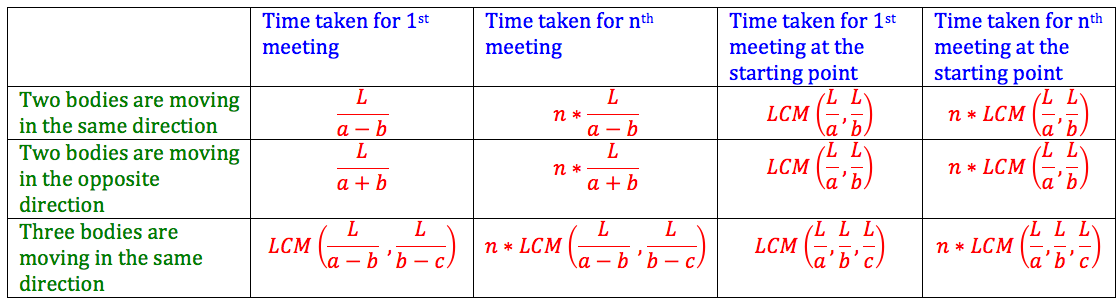
Number of distinct points: In same direction, a-b and in opposite direction a+b (Here a/b is the reduced ratio of speeds).
PRACTICE QUESTIONS
Ex. Walking at 4 / 5 of its normal speed, a school bus is 10 minutes late. Find its usual time to cover the journey.
Solution : New Speed = 4 / 5 of original speed, since the speed and time has inverse relation so,
New Time taken by bus = 5 / 4 of the normal time
( 5 / 4 of usual time ) - ( usual time ) = 10 min.
1 / 4 of the normal time = 10 min
normal time = 40 min
Solution : New Speed = 4 / 5 of original speed, since the speed and time has inverse relation so,
New Time taken by bus = 5 / 4 of the normal time
( 5 / 4 of usual time ) - ( usual time ) = 10 min.
1 / 4 of the normal time = 10 min
normal time = 40 min
Ex. The distance between two stations Delhi and Lucknow is 500 km. A train starts at 5 pm from delhi and moves towards Lucknow at an average speed of 50 km / hr, Another train starts at 4.20 pm and moves towards delhi at an average speed of 70 km/hr. How far from delhi the two trains meet and at what time ?
Solution : Let the two trains meets at a distance of x km from delhi.
Now [Time taken by train from Lucknow to cover (500-x)km] - [Time taken by train from delhi to cover x km ] = 40 / 60

Solution : Let the two trains meets at a distance of x km from delhi.
Now [Time taken by train from Lucknow to cover (500-x)km] - [Time taken by train from delhi to cover x km ] = 40 / 60
Ex. Bullcart A cover a certain distance at the speed of 15 km/hr, another bullcart B covers the same distance at the speed of 16 km/hr. If Bull cart A takes 16 minutes longer than B to cover the same distance find the distance?
Solution : let the distance is x km
Time taken by A= x / 15 hrs
Time taken by B= x / 16 hrs

Solution : let the distance is x km
Time taken by A= x / 15 hrs
Time taken by B= x / 16 hrs
Ex. Ram can cover a certain distance in 1 hr 30 min. By covering two third of the distance at 4 kmph and the rest at 5 kmph. Find the total distance covered ?
Solution : Let the total distance be x km then:

Solution : Let the total distance be x km then:
Ex. A train travells at average speed of 100 km / hr, it stops for 3 mins after travelling 75 kms of diatance. How long it takes to reach 600 kms from the starting point.
Solution : Time taken to travel 600 kms= 600 / 100 = 6 hrs
But it stop after travelling 75 kms , so number of stoping point in 600 kms will be= 600 / 75 = 8, but the last stoping point is actual end stoping so
Number of stoping point will be 7, and time taken= 7*3= 21 minutes
So total time = 6 hrs 21 mins
Solution : Time taken to travel 600 kms= 600 / 100 = 6 hrs
But it stop after travelling 75 kms , so number of stoping point in 600 kms will be= 600 / 75 = 8, but the last stoping point is actual end stoping so
Number of stoping point will be 7, and time taken= 7*3= 21 minutes
So total time = 6 hrs 21 mins
Ex. A is faster than B . A and B each walk 24 km. The sum of their speeds is 7 km / hr and the sum of their time taken is 14 hrs. Then A's speed is equal to :
Solution : Let A's speed = x km / hr and B's speed is = 7 - x km / hr

(x-3) (x-4) = 0
x=3, x=4, So A's speed is 4 km / hr, B's speed is 3 km / hr
Solution : Let A's speed = x km / hr and B's speed is = 7 - x km / hr
(x-3) (x-4) = 0
x=3, x=4, So A's speed is 4 km / hr, B's speed is 3 km / hr
Ex. A man on tour travels first 180 km at 60 km / hr and next 180 km at speed of 80 km / hr . The average speed of first 360 km of the tour is :
Solution : Total time taken = ( 180 / 60 ) + ( 180 / 80 ) = 21 / 4 hrs

Solution : Total time taken = ( 180 / 60 ) + ( 180 / 80 ) = 21 / 4 hrs
Ex. A train running at 3 / 7 of its own speed reached the destination in 14 hours, how much time could be saved if the train would have run at its own speed ?
Solution : New speed = 3 / 7 of normal speed
So, New Time will be = 7 / 3 of normal time. (Invers relation )
As 7 / 3 of normal time is = 14 hours
So, normal time = (14 * 3 / 7 ) = 12 hrs
So time saved = 14 - 12 = 2 hours
Solution : New speed = 3 / 7 of normal speed
So, New Time will be = 7 / 3 of normal time. (Invers relation )
As 7 / 3 of normal time is = 14 hours
So, normal time = (14 * 3 / 7 ) = 12 hrs
So time saved = 14 - 12 = 2 hours
Ex. Speed ratio of two school buses A and B in covering a certain distance is 4 : 5, If A takes 30 minutes more than B covering the distance, then time taken by B to reach the destination is :
Solution : Since speed ratio is 4 : 5
Time ratio will be 5 : 4 , let A takes 5x hrs and B takes 4x hrs to reach the destination then ,

Solution : Since speed ratio is 4 : 5
Time ratio will be 5 : 4 , let A takes 5x hrs and B takes 4x hrs to reach the destination then ,
Ex. Steve traveled the first 2 hours of his journey at 40 mph and the last 3 hours of his journey at 80 mph. What is his average speed of travel for the entire journey?
Solution: Average speed of travel = 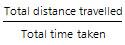
Total distance traveled by Steve = Distance covered in the first 2 hours + distance covered in the next 3 hours.
Distance covered in the first 2 hours = speed * time = 40 * 2 = 80 miles
Distance covered in the next 3 hours = speed * time = 80 * 3 = 240 miles
Therefore, total distance covered = 80 + 240 = 320 miles
Total time taken = 2 + 3 = 5 hours.
Hence, average speed = = 64 miles per hour.
Total distance traveled by Steve = Distance covered in the first 2 hours + distance covered in the next 3 hours.
Distance covered in the first 2 hours = speed * time = 40 * 2 = 80 miles
Distance covered in the next 3 hours = speed * time = 80 * 3 = 240 miles
Therefore, total distance covered = 80 + 240 = 320 miles
Total time taken = 2 + 3 = 5 hours.
Hence, average speed =
= 64 miles per hour.
Ex. Jane covered a distance of 340 miles between city A and city taking a total of 5 hours. If part of the distance was covered at 60 miles per hour speed and the balance at 80 miles per hour speed, how many hours did she travel at 60 miles per hour?
Solution: Let 'x' hours be the time for which Jane traveled at 60 miles per hour.
As the total time taken to cover 340 miles is 5 hours, Jane would have traveled (5 - x) hours at 80 miles per hour.
Distance covered at 60 miles per hour = Speed * time = 60 * x = 60x miles
Distance covered at 80 miles per hour = Speed * time = 80 (5 - x) = 400 - 80x miles
Total distance covered = Distance covered at 60 miles per hour + Distance covered at 80 miles per hour.
Therefore, total distance = 60x + 400 - 80x.
But, we know that the total distance = 340 miles.
Therefore, 340 = 60x + 400 - 80x
=> 20x = 60 or x = 3 hours.
As the total time taken to cover 340 miles is 5 hours, Jane would have traveled (5 - x) hours at 80 miles per hour.
Distance covered at 60 miles per hour = Speed * time = 60 * x = 60x miles
Distance covered at 80 miles per hour = Speed * time = 80 (5 - x) = 400 - 80x miles
Total distance covered = Distance covered at 60 miles per hour + Distance covered at 80 miles per hour.
Therefore, total distance = 60x + 400 - 80x.
But, we know that the total distance = 340 miles.
Therefore, 340 = 60x + 400 - 80x
=> 20x = 60 or x = 3 hours.
Ex. A runs 25% faster than B and is able to give him a start of 7 meters to end a race in dead heat. What is the length of the race?
Solution: A runs 25% as fast as B.
That is, if B runs 100m in a given time, then A will run 125m in the same time
In other words, if A runs 5m in a given time, then B will run 4m in the same time.
Therefore, if the length of a race is 5m, then A can give B a start of 1m so that they finish the race in a dead heat.
Start : length of race :: 1 : 5
In this question, we know that the start is 7m.
Hence, the length of the race will be 7 * 5 = 35m.
That is, if B runs 100m in a given time, then A will run 125m in the same time
In other words, if A runs 5m in a given time, then B will run 4m in the same time.
Therefore, if the length of a race is 5m, then A can give B a start of 1m so that they finish the race in a dead heat.
Start : length of race :: 1 : 5
In this question, we know that the start is 7m.
Hence, the length of the race will be 7 * 5 = 35m.
Ex. A bus travels from town A to town B. If the bus's speed is 50 km/hr, it will arrive in town B 42 min later than scheduled. If the bus increases its speed by 509 m/sec, it will arrive in town B 30 min earlier than scheduled. Find:
A) The distance between the two towns;
B) The bus's scheduled time of arrival in B;
C) The speed of the bus when it's on schedule.
A) The distance between the two towns;
B) The bus's scheduled time of arrival in B;
C) The speed of the bus when it's on schedule.
Solution: First we will determine the speed of the bus following its increase. The speed is increased by 509m/sec =50⋅60⋅6091000 km/hr =20 km/hr. Therefore, the new speed is V=50+20=70 km/hr. If x is the number of hours according to the schedule, then at the speed of 50 km/hr the bus travels from A to B within (x+4260) hr. When the speed of the bus is V=70 km/hr, the travel time is x−3060 hr. Then
50(x+4260)=70(x−3060)
5(x+710)=7(x−12)
72+72=7x−5x
2x=7
x=72 hr.
So, the bus is scheduled to make the trip in 3 hr 30 min.
The distance between the two towns is 70(72−12)=70⋅3=210 km and the scheduled speed is 21072=60 km/hr.
50(x+4260)=70(x−3060)
5(x+710)=7(x−12)
72+72=7x−5x
2x=7
x=72 hr.
So, the bus is scheduled to make the trip in 3 hr 30 min.
The distance between the two towns is 70(72−12)=70⋅3=210 km and the scheduled speed is 21072=60 km/hr.
Ex. Arun, Barun and Kiranmala start from the same place and travel in the same direction at speeds of 30, 40 and 60 km per hour respectively. Barun starts two hours after Arun. If Barun and Kiranmala overtake Arun at the same instant, how many hours after Arun did Kiranmala start?
Solution: As you can see that the speeds are in HP, so we can say that the times taken will be in AP. Time difference between Arun and Barun is 2 hours, so the time difference between Barun and Kiranbala will also be 2 hours.
Hence, Kiranbala started 4 hours after Arun
Ex. Two motorists Anil and Sunil are practicing with two different sports car; Ferrari and Maclarun, on the circular racing track, for the car racing tournament to be held next month. Both Anil and Sunil start from the same point on the circular track. Anil completes one round of the track in 1 min and Sunil takes 2 min to complete a round. While Anil maintains speed for all the rounds, Sunil halves his speed after the completion of each round. How many times Anil and Sunil will meet between 6th round and 9th round of Sunil (6th and 9th round is excluded)? Assume that the speed of Sunil remains steady throughout each round and changes only after the completion of that round.
Solution: Time taken by Sunil for 1st round = 2 min
2nd round = 4min
3rd round = 8 min
4th round = 16 min
5th round = 32 min
6th round = 64 min
7th round = 128 min
8th round = 256 min
⇒ Anil tales one minute for every round.
He meets 127 times in 7th and 255 times in 8th round
Total meet =127+255= 382
Ex. Mukesh, Suresh and Dinesh travel from Delhi to Mathura to attend Janmashtmi Utsav. They have a bike which can carry only two riders at a time as per traffic rules. Bike can be driven only by Mukesh. Mathura is 300km from Delhi. All of them walk at 15km/h. All of them start their journey from Delhi simultaneously and are required to reach Mathura at the same time. If the speed of bike is 60km/h, then what is the shortest possible time in which all three can reach Mathura at the same time?
Solution: Mukesh starts from Delhi (say A).
He has to take of the other two (say Dinesh) on his bike, take him up to a certain point(say C) drop him there and return for Suresh.
He has to take of the other two (say Dinesh) on his bike, take him up to a certain point(say C) drop him there and return for Suresh.
Meanwhile Suresh starts walking.
Suresh and Mukesh meet at (say B) Mukesh picks up Suresh at B and turn towards Mathura.
All of them arrive together at Mathura (say D).
Suresh and Mukesh meet at (say B) Mukesh picks up Suresh at B and turn towards Mathura.
All of them arrive together at Mathura (say D).
A------------ B ------------- C ------------- D
As, M drives at 60km/h and S (as well as D) walk at 15 km/h.
AC + CB = 4(AB)
BC+CB = 3(AB)
⇒ CB=1.5(AB)
Let AB=2, BC=3, (Also CD=2)
Actually, AB=600/7,BC=900/7,CD=600/7
Time taken=65/7hr
Ex. From a point P, on the surface of radius 3cm, two cockroaches A and B started moving along two different circular paths, each having the maximum possible radius, on the surface of the sphere, that lie in the two different planes which are inclined at an angle of 45 degree to each other. If A and B takes 18 sec and 6 sec respectively, to complete one revolution along their respective circular paths, then after how much time will they meet again, after they start from P?
Solution: Both the circular paths have the maximum possible radius hence, both have a radius of 3cm each. Irrespective of the angle between the planes of their circular paths, the two cockroaches will meet again , at the point Q only, which is diametrically opposite end of P.
A will takes 9 seconds to reach point Q, completing half a revolution. On the other hand, B would have completed 3/2 |
of his revolution and it will also reach point Q simultaneously.
Subscribe to:
Posts (Atom)